Work published under the Oravont Systems LLP affiliation since the practice was registered in November 2024, tagged by track. The founder's earlier record — journal and conference papers, a patent as named inventor and two book chapters — is listed, with the full text to download, on suniltyagi.in.
Outputs
Published since November 2024
Preprint · 2026UDADeep learningCC BY 4.0
Open-Set Vessel Re-Identification from Underwater Ship-Radiated Noise with a Raw-Waveform Selective-Kernel Acoustic Neural Network (SKANN) and a Cross-Passage Evaluation Protocol
Formalises open-set, cross-passage vessel re-identification on public hydrophone data; specifies an evaluation protocol with hull-disjoint splits, cross-passage galleries and audio-adjudicated transit deduplication; describes SKANN, a raw-waveform encoder trained with an angular-margin objective; and reports results on IARA, ShipsEar and a cross-network experiment that support analyst triage over a ranked shortlist rather than identification.
System and method for open-set re-identification of individual vessels from underwater ship-radiated noise using a raw-waveform selective-kernel acoustic neural network, and a cross-passage evaluation protocol therefor
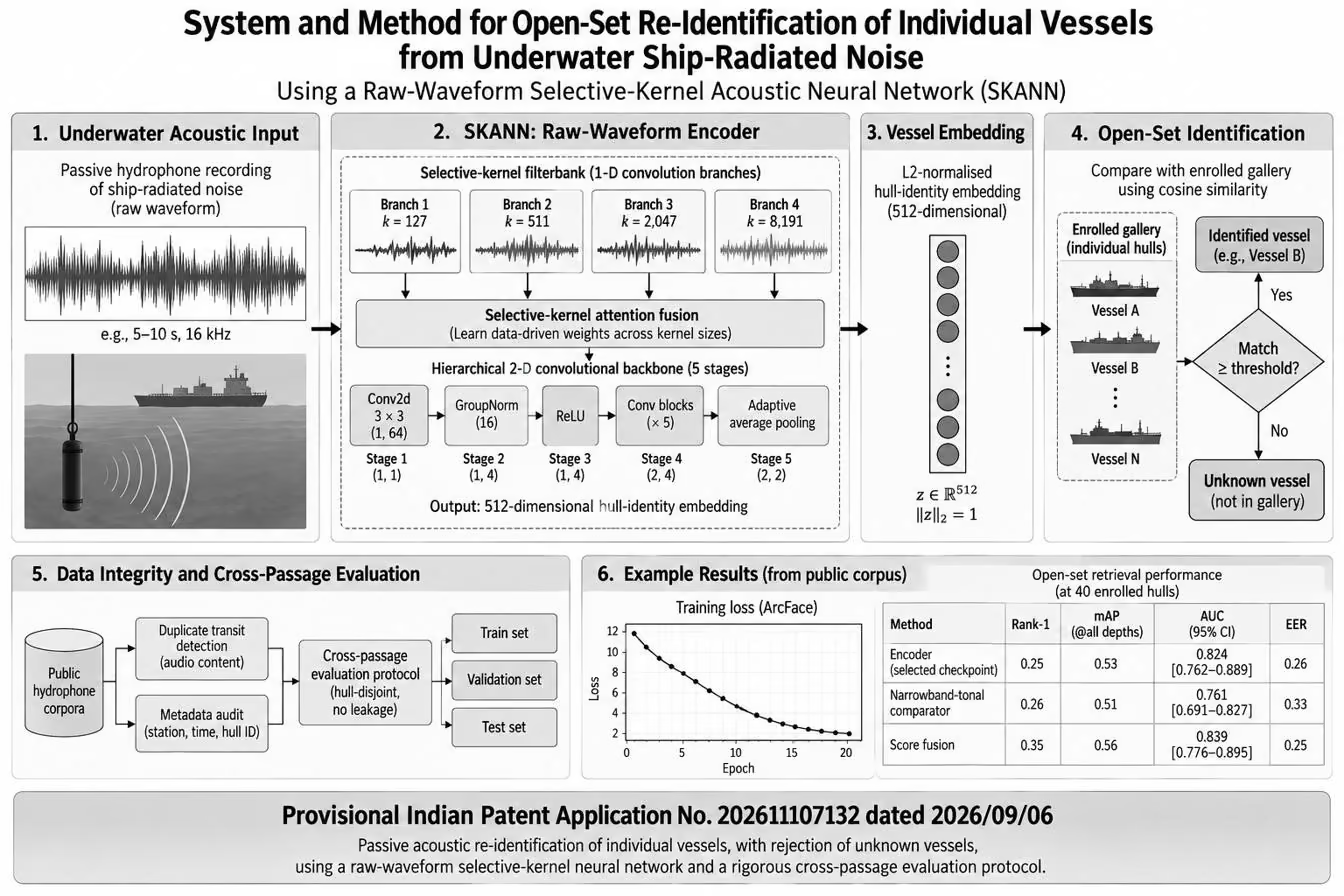
Covers the raw-waveform selective-kernel encoder that builds a hull-identity embedding through multi-resolution processing; the matching of a recording against an enrolled gallery by cosine similarity, with rejection of hulls that are not in it; and the leakage-resistant cross-passage evaluation protocol with transit-level deduplication of source recordings.
Indian Patent Office, provisional application No. 202611107132, filed 6 September 2026 · Applicant: Oravont Systems LLP · Inventor: Sunil Tyagi · Complete specification pending.
Graphical abstract: raw waveform to hull-identity embedding, gallery match or rejection, and the evaluation protocol that keeps the measurement leakage-free.
Research artefacts · 2026UDADeep learningCC BY 4.0
SKANN model checkpoint, validation embeddings, transit map and per-query evaluation outputs
The companion record to the preprint: the model checkpoint with SHA-256 digests, validation embeddings, the transit-deduplication map and per-query outputs, so that every reported number can be recomputed. Source corpora are credited in the record: IARA (CC BY-NC 4.0), ShipsEar (distributed by the Universidad de Vigo on request) and Ocean Networks Canada, Oceans 3.0.
Dataset and article · 2026Deep learningUDACC BY 4.0
A Physics-Grounded Synthetic Underwater Acoustic Dataset for Underwater Domain Awareness
Full-factorial waveform generation from first-principle acoustic models: 12,000 physics-grounded clips across four vessel classes and ambient ocean noise, with corrected ambient-noise modelling, physics-based cavitation and worked verification calculations, released for self-supervised pretraining.
SSR-Sim estimates how strongly a submarine returns active sonar, and says which part of the boat the echo comes from. On a generic 66 m double-hull boat with bare steel plating, it puts the target strength at 43 dB on the beam at 5 kHz, and more than half of that echo comes from the flat sides of the sail. Bow-on, the echo is 33 dB weaker and mostly diffuse scattering from the structure between the hulls.
Tyagi S. Working note, Oravont Systems LLP, 19 October 2026 · Read the note · PDF · Series introduction · An invented hull and an illustrative coating, described at headline level.
Working note and toolkit · 2026UDAStealthMIT · CC BY 4.0
DEMON Analysis: Reading a Vessel's Propulsion from Its Own Noise
A practical walk-through of Detection of Envelope Modulation on Noise: what it extracts, the pipeline (bandpass → Hilbert envelope → AC-coupling → envelope FFT), how to read the harmonic comb, the band-selection decision most tutorials skip, and a case study in which DEMON exposed a defect in a synthetic dataset that conventional spectrograms had hidden. The toolkit that produced the figures is public.
A beginner's tutorial on the physical quantities behind underwater audio data: pressure in pascals, RMS pressure and intensity, sound pressure level in dB re 1 µPa and why it is not comparable with decibels in air, the power spectral density, band levels, spherical-spreading transmission loss, and why synthetic noise is made by synthesising the pressure p(t) from a spectrum, never p²(t). Eight runnable Python examples are shown with their real outputs, and the figures are computed from the same formulas.
Deep Learning for Underwater Domain Awareness — capability overview
Passive-sonar acoustic intelligence at an unclassified, public level: the DEMON toolkit, the SKANN architecture, the PS12 detection-and-classification system and the DISC5 re-identification work, with the deployment principles behind them.
An edition of Quantum Computing for the Quantum Curious by Ciaran Hughes, Joshua Isaacson, Anastasia Perry, Ranbel F. Sun and Jessica Turner (Springer, 2021, CC BY 4.0), edited by Sunil Tyagi: retitled, with a new cover and front matter; the chapters are unchanged. An independent edition, not endorsed by the original authors or by Springer.
Programme specifics, customer data and evaluation results from sponsored work are not disclosed. The enrolment-and-inference application built for the DISC5 programme is public on GitHub; its training code and documentation are held privately.