
Six problems a quiet platform has to solve
01Acoustic modelling and underwater radiated noise (UWRN) estimation
A platform-level acoustic model of noise generation and propagation, and the total radiated noise it predicts under each operating condition. Radiated noise is cheapest to reduce before the platform is built, while the machinery, mountings, pipework and propeller can still change.
- Structure-borne noise (noise carried as vibration through the hull structure before it radiates into the water) from vibro-active equipment (machinery that vibrates when running, such as pumps, fans and motors) and systems-pipeline noise (noise carried along pipework and the fluid in it).
- Airborne noise from vibro-active machinery.
- Propeller noise, including its interaction with the hull and appendages (parts that project from the hull, such as the rudder, hydroplanes and sail).
- Anechoic (hull coatings that absorb incoming active-sonar energy, reducing the echo), sound-insulation (coatings that block sound passing from inside the hull into the water) and vibro-damping (coatings that turn structural vibration into heat, so less of it is radiated as noise) coating schemes, and mitigation strategies ranked by effect on the signature (the acoustic characteristics by which a vessel can be detected or identified).
Underwater radiated noise prediction at the design stage →
Dhvanyakalan: design-stage software for underwater noise from working machinery →
02Sonar signal reflection and target strength
How a hull returns active sonar, and how to return less of it. Target strength is how strongly a hull returns active-sonar energy, in decibels. A vessel's reflection signature is governed by geometry, materials, coatings and structure.
- Decomposition of the hull and structures into simple reflective elements from line plans (the drawings that define the shape of the hull) and structural data.
- Specular (mirror-like reflection from the outer surface), diffuse (scattering from frames, tanks and pipes between the hulls) and non-specular (re-radiation from the stiffened shell) components, summed on an energy basis (added as intensities, without regard to phase) into the cumulative return (the echo of the whole hull).
- Effectiveness of anechoic coatings and structural modifications; recommendations on hull form, coatings and fittings.
- Submarines, surface ships and specialised naval platforms.
SSR-Sim: target strength software for early design →
On a generic 66 m double-hull submarine with bare steel plating, SSR-Sim puts the target strength at 43 dB on the beam (side-on to the sonar) at 5 kHz, more than half of it from the flat sides of the sail (the submarine's fin, the tower above the hull).
03Acoustic interference to own sonar
The noise a platform makes is also the noise its own sonar has to listen through. Interference is estimated at the sketch-design stage (the earliest design stage, when the general arrangement is first drawn), so that mitigation is designed in rather than bolted on.
- Five components: radiated noise from the hull, machinery vibration, hydrodynamic turbulence (pressure fluctuations in the water flowing over the hull near the sonar), airborne noise, and structure-borne noise into the sonar.
- Frequency-specific modelling across the sonar's operating band.
- Noise isolation, vibration reduction and structural options, weighed against the sonar's detection performance.
04Airborne noise and habitability
Compartment noise levels during design, so that resting quarters and watchkeeping stations meet the staff requirements before the platform is built.
- Noise at specified locations within compartments, across octave bands (frequency bands whose upper edge is twice the lower) from 31 Hz to 8 kHz.
- Contributions from machinery, ventilation systems and structural paths.
- High-noise zones identified early, with targeted damping and insulation changes.
05Shock, noise and vibration control
A safe, durable onboard environment for equipment and crew: the shock, vibration and noise limits that equipment must meet, and the mounting schemes that let it meet them.
- Shock-mounting scheme design; shock strength (the equipment's ability to withstand a specified shock without damage or loss of function) for equipment under underwater explosion (UNDEX) loading.
- Vibration limits and isolation of machinery, systems and pipelines.
- Equipment noise and vibration limits, and measurement to validate performance against them.
06Mast vibration and design
Masts carry periscopes, sensors, antennas and electronic-warfare systems, and they sit in the flow. Vibration control keeps the sensors accurate, the signature down and the structure sound.
- Natural frequencies (the frequencies at which a structure or mounted item vibrates freely once disturbed) and resonance (the large response when a structure is excited at one of its natural frequencies); the added-mass effect of the surrounding water (the water that moves with a vibrating mast, adding to its mass and lowering its natural frequencies).
- Vortex shedding (vortices breaking away alternately from each side of a mast, pushing it from side to side) and flow-induced vibration (vibration driven by water flowing past a structure); steady and unsteady drag and lift (the mean and fluctuating forces of the flow, along and across the mast).
- Stiffness, mass distribution and damping refinements; sensor and antenna performance under dynamic flow.
Engineering software
Dhvanyakalan (ध्वन्याकलन)
Estimates the underwater noise that a submarine's working machinery radiates, compartment by compartment, at the design stage. It uses an empirical method (one built on measured data rather than first-principles physics), validated against physical experimental results. Developed at Oravont by Capt (Dr) Sunil Tyagi.
- Hull, bulkhead and deck structure; coating efficiency (how much a hull coating reduces the noise radiated, at each frequency) from 5 Hz to 10 kHz.
- Vibration spectra of machinery and valves; mountings and vibration absorbers (tuned devices that soak up vibration at a target frequency).
- Coating efficiency and underwater noise levels, 5–200 Hz and 250 Hz–10 kHz.
SSR-Sim
Simulates and analyses sonar signal reflections from submarine hulls and naval structures, for stealth design and research. Developed in-house by Oravont's founder, Capt (Dr) Sunil Tyagi.
- Specular, diffuse and non-specular components.
- Frequencies, depths and relative bearings (directions to the target measured from the ship's own heading).
- Early-stage evaluation without physical prototypes.
Working note by Sunil Tyagi (2026): what a submarine's sonar echo is made of →
ABNContour
Estimates and maps airborne noise in the compartments of ships and submarines during the design phase.
- Noise levels at specified locations; octave bands 31 Hz – 8 kHz.
- Contributions from machinery, ventilation and structure.
- Compartment noise profiles and high-noise zones.
SMS-Suite
Mathematical simulation and optimisation of shock-mounting systems for ship equipment: statics and dynamics at the design stage.
- Dynamic models from foundation, mass, body and mount elements, with automated equations of motion.
- Natural frequencies, static displacements (how far the mounts deflect under steady loads such as the equipment's weight), shock impulses (the short, sharp acceleration pulses that a shock delivers to the foundation), forced oscillations (vibration driven by a continuing excitation, such as running machinery), quasi-static effects (slowly varying loads, such as ship motion or a steady heel, that can be treated as static).
- 3-D visualisation; libraries of masses, mounts and impulses; CAD import (computer-aided design models from CATIA, a 3-D design package).
The tools are Oravont's own and are made available to defence organisations, shipyards and research institutions on enquiry through the Contact page.
Where this comes from
The practice's stealth work rests on its founder's six years in the Indian Navy as head of the Acoustic Stealth Group of the Submarine Design Directorate, Naval Headquarters (2015–21), the group responsible for low underwater noise in submarine design across India's nuclear-submarine programme; on the sea and dockyard appointments that preceded it; and on the trials-and-acceptance appointment that followed. His Navy work from that period, before Oravont, at the level it can be described publicly, includes:
- India's first indigenous submarine acoustic model, developed by Sunil Tyagi for the Navy (not an Oravont product), for predicting underwater radiated noise from machinery, propulsors and onboard systems.
- A standardised shock-mounting design methodology covering equipment centre of gravity, vacuum load (the pull of a condenser operating under vacuum, which its mounts carry along with the machinery's weight), torque, tug-pull forces (forces acting at right angles to the mounts' load-bearing direction, as from a winch or windlass hauling a line), mount compression under shock (how far the mounts are compressed when the shock pulse drives the equipment into them), roll and pitch effects (the extra loads on the mounts as the ship rolls and pitches at sea) and transmissibility (the ratio of the vibration a mount passes on to the vibration it receives; below 1, the mount isolates).
- Statements of requirement (the Navy's formal documents setting out what a new item of equipment must do) for indigenous shock mounts, flexible inserts (flexible joints between vibrating machinery and its pipework that keep vibration out of the pipes) and vibro-damping coatings, and qualitative requirements for indigenous anechoic coatings.
- A submarine mast redesign that introduced vortex-shedding, resonance and added-mass assessment and a time-variant analysis of drag and lift forces.
- A shock-analysis tool that automates the estimation of shock amplitude and pulse width (the peak acceleration of the shock pulse, and how long the pulse lasts) on board under far-field underwater-explosion (UNDEX) loading — the regime addressed by shipboard shock-qualification standards such as MIL-DTL-901E (the US Navy's specification for high-impact shock testing of shipboard machinery and equipment, dated 20 June 2017, which replaced MIL-S-901D).
The full record is on suniltyagi.in.
Questions this track is asked
- What is underwater acoustic stealth?
- Underwater acoustic stealth is the design discipline of keeping a submarine or ship hard to hear and hard to find with sonar. It covers the noise the platform radiates, the active-sonar energy its hull reflects, and the self-noise its own sonar must listen through. All three are best addressed early in design, when changes cost least. Shock and vibration control is a related discipline on the same track. It keeps equipment working under underwater-explosion loading and limits the vibration that becomes noise.
- What is underwater radiated noise?
- Underwater radiated noise (URN, or UWRN) is the sound a vessel puts into the water: machinery tonals (single-frequency lines in the noise, from rotating or reciprocating machinery) carried through the structure, propeller noise including cavitation (vapour bubbles forming and collapsing at the propeller blades, a strong source of noise), and flow noise. It is usually given as a source-level spectrum in decibels re 1 µPa at 1 m (the sound level against frequency, referred to 1 m from the source, in decibels relative to one micropascal), often in one-third-octave bands (bands one third of an octave wide, the upper edge about 1.26 times the lower). Together with propagation loss (the drop in sound level as it travels through the water), ambient noise (the background sound of the sea: waves, rain, shipping and marine life) and the listener's sonar, it governs how far away a vessel can be detected. The International Maritime Organization (IMO) has also issued guidelines on reducing it, to protect marine life.
- What is target strength?
- Target strength is how strongly a hull returns active-sonar energy, in decibels: the echo intensity referred to 1 m from the target, relative to the incident intensity. It varies with aspect and frequency, and depends on geometry, materials, coatings and structure. It is reduced through hull form, fittings and anechoic coatings.
- How is a vessel's radiated noise reduced in design?
- The main measures are resilient mounting of machinery (mounts with an elastic element, usually rubber, between the equipment and its foundation), isolation of pipework, decoupling (layers that separate a vibrating surface from the water or structure around it) and damping treatments, and propeller and stern design that raises cavitation inception speed (the speed at which the propeller starts to cavitate) and improves the wake (the disturbed flow behind the hull) that the propeller works in. A platform-level acoustic model decides which measures to apply and where. It predicts structure-borne, airborne, propeller and systems-pipeline noise under each operating condition, finds the dominant paths, and ranks each option by its effect on the signature.
Why a stealth designer builds detectors
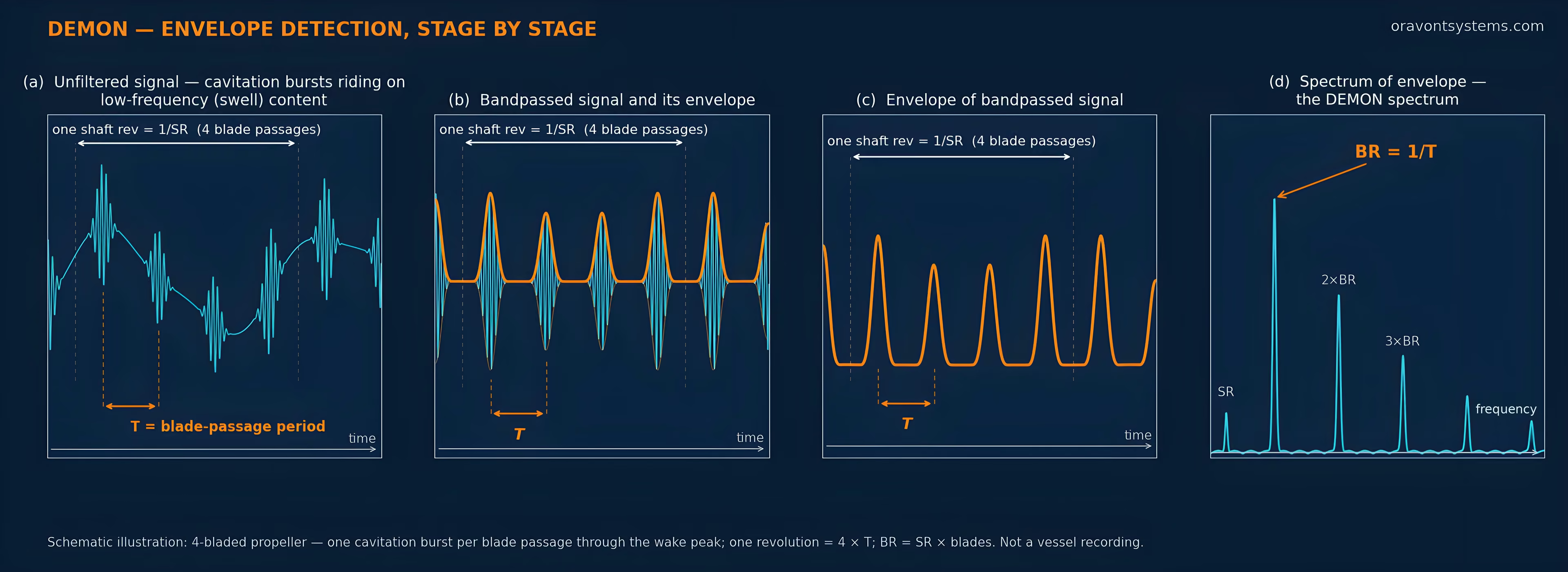
Everything a stealth designer suppresses is something a detector can key on. Cavitation modulated at the blade rate, machinery tonals at shaft and generator lines, flow noise over the hull: the UWRN model that predicts them for a design is the same physics that DEMON (Detection of Envelope Modulation on Noise) reads from a recording and that SKANN, Oravont's Selective-Kernel Acoustic Neural Network, learns to represent. A target-strength model that says how a hull returns active sonar also says how detectable it is. Oravont works on both sides of that ledger deliberately, and each side sharpens the other.
Listening for what stealth suppresses
DEMON reads cavitation and blade-rate lines; SKANN classifies and re-identifies by the same signatures. The stealth models tell those systems what to expect to hear.
Open the track → 02 · Deep learning for UDAAcoustic modelling, reused as training data
The synthetic dataset (12,000 clips in physical units, public under CC BY 4.0 on Hugging Face) and the augmentation regime are built from the same understanding of how machinery, propellers and hulls make noise.
Open the track →Work with Oravont. To discuss a project, write to info@oravontsystems.com, call +91 99222 42303 or use the contact page. Oravont Systems LLP, Noida, India.